Loading…

Plot Eval
Plot Eval is property research software; this curriculum is our public, structured reference for how to work tax liens, tax deeds, foreclosures, assignments, and land lists—from habits and workflow through a repeatable scoring lens.
Distressed property research curriculum
A professional framework for tax lien, tax deed, foreclosure, contract assignment, and land-list diligence—from first principles through a repeatable workflow and a simple scorecard you can use on every lead.
Educational reference only. Not legal, tax, or investment advice. Verify all facts with qualified professionals and official records in your jurisdiction.
1. Foundation: what every serious list researcher should master
1.1 Know exactly what you are buying
Start by identifying the instrument, not just the parcel. A tax lien sale may convey a lien certificate rather than fee-simple ownership. A tax deed sale may transfer a real estate interest subject to specific sale terms. Foreclosure lists can represent very different stages. Assignment sales may involve rights under a contract rather than title to the land. If this step is wrong, downstream diligence can be directionally misleading.
1.2 Build a county-by-county rules file
Before deep work on individual assets, maintain a concise rules sheet for each county or state you operate in: sale type, bid method, deposits, redemption rights, sale terms, as-is language, whether quiet title is commonly needed, and whether taxes, utilities, or other municipal claims may survive. Jurisdictions expect bidders to perform independent due diligence rather than rely on informal staff answers.
1.3 Treat title, access, zoning, and environmental issues as first-class risks
Strong researchers do not stop at “taxes are delinquent” or “the auction discount looks good.” Title defects, easements, buildability, flood and wetlands constraints, legal-lot issues, and lack of physical or legal access often drive outcomes. Recorded deeds, plats, easements, and restrictions should be verified independently; zoning and buildability often require formal confirmation from the authority of record.
1.4 Use a repeatable due-diligence stack
For every lead, work through a consistent stack, adapted to your list type:
- County tax record and treasurer context
- Assessor record and valuation context
- GIS parcel map and geometry sanity check
- Deed chain and plat review where applicable
- Zoning and permitted use verification
- Flood and wetlands screening using authoritative mapping for that jurisdiction
- Environmental red-flag review appropriate to the asset class
- Sales and listing history for exit realism
2. Universal due-diligence workflow (any list)
Step 1 — Normalize the record
Confirm parcel identifier, situs address, legal description, owner name, mailing address, and county or geographic keys. A single bad match propagates into comps, zoning, GIS, and title work.
Step 2 — Confirm the sale mechanism and current stage
Clarify whether the lead is a lien sale, deed sale, sheriff sale, judicial foreclosure, pre-foreclosure marketing, or contract assignment. Valuation, timeline, risk, and exit strategy all depend on that mechanism.
Step 3 — Verify title path and encumbrance risk
Review deed history, plats, visible easements, rights-of-way, restrictive covenants, and open lien indicators. A full title opinion or policy may require a qualified professional; the goal at list stage is to know where uncertainty is concentrated.
Step 4 — Verify zoning and legal lot status
Do not assume a parcel is buildable because it appears on a map. Use zoning verification, compliance letters, or lot-validation processes where the jurisdiction offers them—especially for land and teardown strategies.
Step 5 — Check physical and environmental constraints
Review flood and wetlands exposure, slope and topography, obvious contamination risk, access, and utility availability. Screening is not the same as a professional environmental assessment; it tells you when to escalate.
Step 6 — Underwrite exit, not just entry
Estimate realistic resale or refinance value, hold costs, legal or cleanup costs, title-curative costs, and time to monetization. Ask how you get out, how long it takes, and what breaks your thesis between purchase and exit.
3. Tax lien research
3.1 Understand the product
In many jurisdictions you are buying a tax lien certificate or claim on the tax stream—not immediate ownership of the real estate. Returns depend on redemption mechanics, timing, and statutory process, not only underlying real estate value.
3.2 Research the county’s lien economics
Study bid format, interest and penalty structure, registration requirements, redemption period, and any over-the-counter or secondary-market rules. Economics are governed by local law and auction procedure.
3.3 Research collateral quality anyway
Even when the primary return is redemption yield, underwrite the parcel as if you might need to enforce or carry it. Access, legal lot status, flood exposure, nuisance risk, demolition risk, and resale matter when redemption does not occur.
3.4 Research lien stack and municipal exposure
Confirm what else may be owing: utilities, municipal liens, nuisance abatement, special assessments, or later tax years. The headline delinquency is rarely the entire exposure picture.
3.5 Research redemption likelihood
Consider owner profile, mailing versus situs, occupancy clues, equity context, and whether the parcel appears abandoned. Strong paper yield can pair with fast redemption; non-redeeming collateral can carry operational depth.
4. Tax deed research
4.1 Understand what the taxing authority is selling
Tax deed sales are closer to an ownership transfer, but title quality and encumbrance survival vary by jurisdiction. Research what liens or interests may be extinguished versus what may survive the deed.
4.2 Research surviving title problems
Emphasize easements, restrictive covenants, access, legal description defects, occupancy, and whether marketable title may require curative work. Winning the auction is not the same as being able to sell, finance, or develop immediately.
4.3 Research possession and condition risk
Assume as-is terms and limited interior access. Condition, occupancy, and cleanup can move true economic basis far from the bid number.
4.4 Research utilities and buildability
On vacant or marginal land, verify road access, utility extension reality, septic or well feasibility, flood and wetlands constraints, and zoning compliance. Many tax-deed land strategies fail on infrastructure and permitting, not on auction price.
5. Assignment sale research
5.1 You may be buying contract rights, not title
An assignment typically transfers contractual position in a purchase agreement. Risk concentrates in the contract and counterparty behavior, not only in the parcel itself.
5.2 Read the contract for assignability
Confirm assignability, any seller consent requirement, deadlines, surviving contingencies, earnest money handling, and default remedies. An attractive fee is irrelevant if the agreement is non-assignable or already in breach.
5.3 Verify local legal and compliance posture
Assignment and wholesaling activity can implicate disclosure, licensing, or contract-form rules that differ by state and locality. Treat compliance as part of deal risk, not an afterthought.
5.4 Underwrite disposition risk
Stress-test whether you can assign or close before contractual deadlines. Marketability, title readiness, buyer demand, and obvious property defects can all blow up the exit to your end buyer.
6. Foreclosure research
6.1 Identify the stage of distress
Separate pre-foreclosure marketing, scheduled sale, postponed sale, sheriff or trustee sale, judicial sale, and lender REO. Timing and certainty differ materially at each stage.
6.2 Understand servicer process and borrower rights
Loss-mitigation and servicing rules can affect timelines. Scheduled sale dates are not always final; postponement and reinstatement remain live questions until you confirm status from authoritative sources.
6.3 Research sale terms and bid logistics
Auction terms often specify as-is sale, deposit rules, bid increments, and buyer-borne diligence. Economic edge is frequently lost in mechanics: deposits, opening bids, postponements, and post-sale possession surprises.
6.4 Research lien position and occupancy
Determine what is senior, what may survive, whether taxes or association obligations remain, and whether the property appears owner-occupied, tenant-occupied, vacant, or contested. Post-sale possession and surviving obligations often decide viability.
7. Land-list research
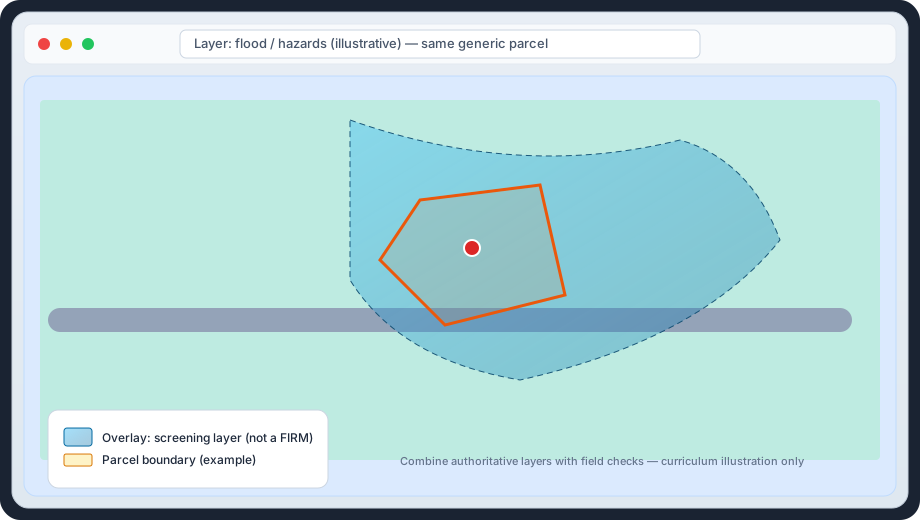
In software like Plot Eval, choosing a property typically recenters the map on the parcel, draws the boundary, and shows a resolved address line so you can orient field and record research. The mockups below use a generic address and shapes only—they are not real parcels or official maps.

7.1 Start with legal lot and permitted use
For raw land, the first question is whether the lot can legally be used the way you intend—not only what it might sell for. Use official zoning determinations or compliance letters where available; use formal lot-validation if legality is unclear.
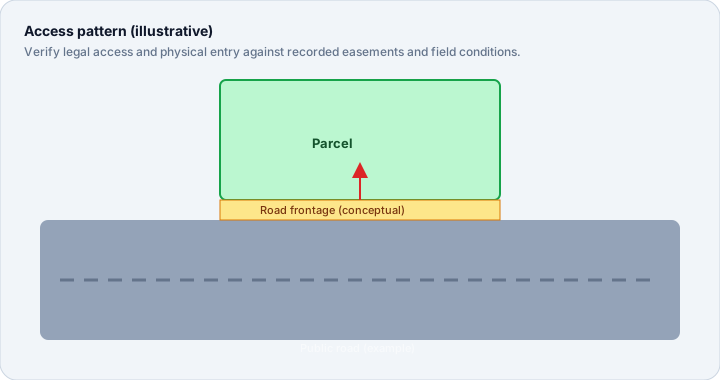
7.2 Confirm access and encumbrances
Research recorded easements, rights-of-way, deed restrictions, and whether access is both legal and practical. Older instruments can bury constraints that are easy to miss on a map alone.
7.3 Confirm environmental and site constraints
Overlay flood and wetlands mapping, topography, and a practical environmental red-flag pass. Raw land issues are often invisible until you combine the right layers.
7.4 Confirm utilities and development practicality
Check water, sewer or septic, power, road frontage, and whether the jurisdiction will issue permits under current conditions. Cheap acreage without serviceable utilities often becomes long-duration inventory.
8. Professional scoring lens for every lead
A simple five-part scorecard keeps underwriting disciplined. Plot Eval’s grades and checklists can support parts of this picture where your data and county coverage allow—they do not replace legal or field verification.
8.1 Legal / title
How clean is the title path, access, lot legality, easement burden, and survivability of encumbrances through your acquisition path?
8.2 Physical / site
How usable is the parcel physically: topography, flood and wetlands, access, and observable condition?
8.3 Marketability
Can you realistically resell or refinance within your target window and buyer pool?
8.4 Timeline
How long until monetization? Include redemption, curative title work, court process, occupancy resolution, and cleanup.
8.5 Margin of safety
Does the spread survive if your key assumptions are wrong?
Using this with Plot Eval
Plot Eval helps you normalize lists, resolve parcels, enrich with county GIS where supported, score site and investment signals where data allows, and run a structured research checklist per property—alongside notes, status, reminders, and team workflow.